
-
Nothing is wrong with Utilitarianism | It’s actually the Best


Utilitarianism is not the moral boogeyman that many make it out to be. Many of the objections to the theory come from misunderstanding its core principles, or actually creating straw men out of its arguments. As I will argue below, John Stuart Mill’s conception of Utilitarianism is a philosophically solid and human-directed attempt at outlining a practical moral theory.
Before I go over the theory and its relevant parts, it’s important to address the numerous misconceptions in regard to Utilitarianism (also referred to as utility). Many often attempt to describe Utility as the greatest good for the greatest number, which has the benefit of making the theory easy to debunk, but it is not an accurate summary.
We have all heard of something like this before:
- There is a train heading down a track toward a group of people.
- If the train is left on its course, it will kill 5 people.
- If we divert the train to a different course, it will only kill 1 person.
- Should we divert the train? Utilitarianism would say so, no matter who the individuals are. Even if there were 5 murders and 1 innocent child, we should still divert the train. Therefore, Utilitarianism can permit some awful actions and even call them moral, so the theory is not so good.
This might be along the right track (no pun intended) if we were dealing with this kind of dumb downed Utility. But the fact is, we have better theories of Utility than this immature conception. It’s just a shame that most people who should understand this fact seem to oversimplify and misconstrue what Utility entails in its strongest form.
“I believe that the very imperfect notion ordinarily formed of its [Utilitarianism] meaning is the chief obstacle which impedes its reception”
Simple translation: “People misunderstand the theory, and that it is the biggest problem to overcome.”
– John Stuart Mill, Utilitarianism

What does John Stuart Mill say about Utilitarianism?
According to Mill’s theory of Utility, as outlined in Utilitarianism (here is a link to a free copy of the book), we should act so as to keep the happiness of all human beings in mind, although the theory could be adapted to include all animals as well. We value equality, so we should care about the rights, freedoms, and happiness of our neighbors at the same time as we care about our own. As a result, he outcomes of our actions should be the primary thing we care about because we always act to produce a certain outcome, namely, happiness or pleasure. This is known as the Greatest Happiness Principle, or GHP for short.
What is the Greatest Happiness Principle?
To begin with, Mill actually states his Greatest Happiness Principle very simply in the opening pages of Utilitarianism.
“…actions are right in proportion as they tend to promote happiness, wrong as they tend to produce the reverse of happiness.”
– John Stuart Mill, UtilitarianismPretty simple. The only thing to remember here is that all happiness is treated equally. We can’t act to only produce our own happiness, that would be very immoral.
However, Mill defines Happiness as the feeling of pleasure, and the absence of pain, and unhappiness as pain without pleasure. Unfortunately, there is a sort of aversion to the word pleasure, as if pleasure is some hedonistic concept that makes people neglect morality.

Pleasure does not mean only basic sensual pleasures
Photo by Wendy Wei on Pexels.com
How do we Rate our Happiness?
Mill clarifies his thoughts on the idea of pleasure by invoking some straightforward thinking. Let me use a modern-day analogy to better show his argument. If we wanted to figure out what the best movie of all time was, we might ask movie critics. We might conduct a survey with people who are avid movie watchers, they have seen a lot of movies, so they may have a good idea of what the best one is. Now let’s take this same idea, but with pleasure.
If we wanted to figure out what the best pleasures were, maybe reading a novel as compared to getting drunk, we would ask people that have experienced both and see which one they prefer. This is what Mill calls a competent judge or someone that has experienced a lot of pleasures and is competent enough to determine which ones are better than others. Just like our movie critic is a competent judge of movies, the pleasure critic is a competent judge of pleasures.
When using this line of reasoning, it seems that competent judges generally prefer reading a novel to getting sloshed. Or maybe going on a trip through Europe, rather than spending the money on a new iPhone or drugs.
So, not all pleasures are equal, and some forms of happiness are preferable to others, albeit, at different times. What is important is both the quantity and the quality of the pleasure experienced.

Photo by Designecologist on Pexels.com
What are the objections to Utilitarianism?
Now that we have a fundamental understanding of Utilitarianism, we can look at some of the prominent objections to the theory to see if they hold water. *Important* Not all of the objections can be discussed here, as some require the theory to be more nuanced to understand, but I urge you to read the text yourself to hear how Mill himself counters these objections. The book is very short for philosophical work and not the most challenging one to read.
Main Objection: The train analogy mentioned at the beginning of this article is the most common type of objection I have heard. Here is a link to an objection of this type on the website Psychology Today. The specific one used in this article follows like this:
- In a small town, a crime has been committed.
- The townspeople are pissed and causing unrest.
- If you were a judge who believes in Utilitarianism, you would find it morally permissible to condemn an innocent person to appease the mob.
This is a rather pernicious straw man of Utilitarianism. The objection tries to show how Utilitarianism is not compatible with the idea of Justice and individual rights, but this is not the case at all.

Photo by LT Chan on Pexels.com Firstly, Mill outlines his view of justice and morality in the second half of Utilitarianism, and the two concepts are deeply respected, but occupy different areas. Justice, for Mill, protects the rights and freedoms of individuals in order to provide benefits for the people. You can demand someone to respect your rights, but you cannot demand someone to treat you morally, like being generous towards you. We all have to feel secure that we are equally protected. It would not be an ideal world if the government could sweep in and deprive us of our rights, freedoms, or even our very lives, at any moment.
This is exactly why we should not kill the innocent person to appease the crowd. A precedent would then be set which undermines the security of all in the town. Think of living in Salem, Massachusetts, and wondering if you’ll be accused of witchcraft (in 1692, of course). Accusing and condemning innocent people is not for the benefit of everyone’s happiness if we believe that security and equality are better than revenge or appeasement. No one wants to worry about “What if that happens to me?”, so we should do our best to make sure our actions are backed up by evidence and consideration of the facts. Long-term effects must also play a role, not just “in the moment” pleasures which is what a lot of critics seem to address exclusively.
Other Objections: There are a variety of objections that can be created against Utilitarianism, and unfortunately it is not within the scope of this article to address them all (Here is a helpful resource if you are interested). However, we can use our understanding of the principles of Utilitarianism to counter many objections. For that reason, I have created this image to try to make it as simple as possible. Yet, there is a lot more complexity than I have addressed here, so for that reason, I recommend reading the book itself (it’s only about 60 pages).
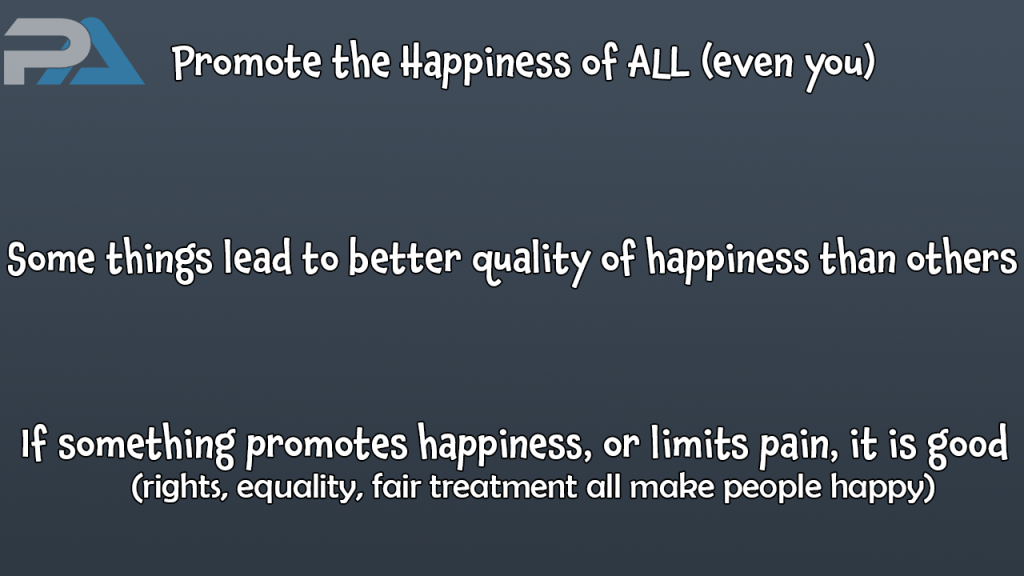
What is the greatest strength of Utilitarianism?
Utilitarianism provides a practical, straightforward, and somewhat intuitive approach to ethics which makes it very easy to apply to everyday life. Human beings are already Utilitarians of a sort. We recognize that we should care about others, and their freedoms, we just haven’t had a theory outline our beliefs in such a way. If we were all devout Utilitarians, the world would be in a much better place as the happiness of all would not remain as a part of an old theory, but as the actual standard by which we act. Utilitarianism is not deserving of the criticism it has received, and Mill was probably correct when he asserted that its misunderstandings were its biggest obstacle.
-
The 3 Best Philosophy Books (that no one talks about)

In terms of philosophical works, there is a lot out there. Yet I would bet that you have not heard of authors such as Friedrich Schiller and Johann Gottfried Herder, and you may have heard of Henry David Thoreau. These authors present some amazing ideas that can be effectively applied to everyday life. The works I will be looking at are:
- Walden, Henry David Thoreau
- Another Philosophy of History, Johan Gottfried Herder
- On the Aesthetic Education of Man, Friedrich Schiller
Many people often cite Plato as one of the main authors to seek out when studying philosophy, and while he is relatively easy to follow and presents some genuinely interesting arguments, he simply isn’t that practical. Some of his arguments can be successfully argued against, and some others are highly debatable. He is excellent for an introduction in philosophy, he is just not that convincing.
The texts that I will recommend below are more difficult than Plato, for the most part. But I can also say that they are worth it. Harder, but much more enlightening and practical than what may be contained in the Republic. It was by almost accident that I even encountered these works in the first place.
During my final semester in my undergraduate program, I had to take a seminar course following a particular series of texts that my professor chose. Throughout my entire academic career, I had never heard of Herder or Schiller and never encountered Thoreau as a genuine philosopher. For this, I have to thank my professor for the introduction.

Image from Gutenberg.com - Walden, Henry David Thoreau
Walden is not often thought of as a philosophical work. Yet the text does philosophize quite a bit, at times not reaching a definite conclusion. Thoreau left the society in which he lived (1845 Massachusetts) to live in the woods for a short time, about two years. During this time, he recorded his thoughts, observations, and the manner in which he lived. He subsisted on only the necessities, limiting his diet to a meager amount and his possessions to near destitution.
This situation provoked a lot of thought for Thoreau, mostly revolving around living a simple, wise, and free life. Even I have to admit that not all of Walden’s sections are super insightful, they may just be his observations of his surroundings. If the entire text does not interest you, I took the liberty of jotting down the most philosophically important chapters, in my opinion, of course.
Where I lived, and What I lived for
Higher Laws
Conclusion

Photo by Andru00e9 Cook on Pexels.com

Image from Amazon.com - Another Philosophy of History, Johan Gottfried Herder
Another Philosophy of History by Herder was a very surprising text when I had first read it. Herder attempts to look at human history as a whole and examine an individual’s place within it, as well as examine how culture changes over time. Herder asks important questions that I and my classmates seemed to never explore before, for instance, do rationality and enlightenment values actually improve life? Or is it merely coincidental that human life improved when enlightenment values were adopted?
Whether or not you agree with Herder, this book attempts to get you to question the trends that take place within society. Ultimately, after reading it, I came away with the idea that cultures and large scale operations are adrift at sea, and their ends may not be within their own control. Maybe we don’t have as much impact on the changes that occur within our lifetimes that we like to believe. If so, then we can sit back and enjoy the ride.
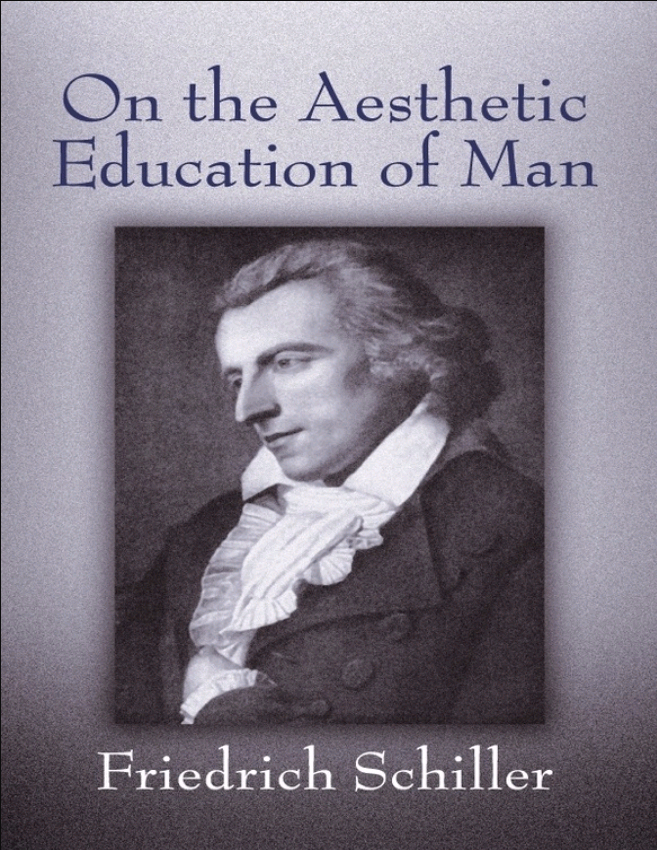
Image from On the Aesthetic Education of Man, Dover Publications - On the Aesthetic Education of Man, Friedrich Schiller
This one is last on the list for a very important reason, it is (in my view) the best of these texts, but also right up there with Kant in terms of difficulty. Schiller takes a very philosophic approach to flushing his vision out of what constitutes Beauty, and the implications that come from it. Beauty? But how is that a philosophically relevant topic?
Well, that’s what I thought at first. Yet Schiller completely blew my expectations out of water. This text uncovers an inspiring account of what exactly beauty is, and it turns out that beauty may be one of the most important factors determining human behavior and can give us hints into how one ought to live the good life. If you have the patience to work through this brief, but dense text, I would recommend it highly.
-
How can Philosophy help your life?

Philosophy can help your life in many ways, despite common misconceptions. It becomes easy to dismiss the value philosophy can provide when faced with material issues. How is philosophy going to help put food on the table? Can it pay my rent? Or is it just a hobby, like painting or making music?

It can be very difficult to see philosophy’s benefit when faced with questions like these. It’s not so easy to see the cause and effect of philosophy in the same way you might see the cause and effect of going on a diet. Maybe this is why we ask the question “what can philosophy do for me?” in the first place.
The Value of Philosophy
At the end of Bertrand Russell’s book The Problems of Philosophy, he includes a short chapter titled The Value of Philosophy[1]. In this chapter he outlines what he believes the value of philosophy to be, namely, that it provides “food for the mind”[2]. Russell believes that philosophy addresses an important, but commonly underrecognized, aspect of human beings. It is definitely true that we need food to survive, and shelter to keep warm, but these are not the only conditions necessary to human flourishing. He even goes so far as to say that a society that provides the best material wellbeing for its people (everyone has a home, food, and clothing) would still need to do a lot to become a valuable society. That’s a very bold statement, but is there truth to it?

Is Philosophy Practical?
Have you ever wondered deeply about something? It could really be anything. Movies, stars, history, or anything at all? This feeling of curiosity, and that there is more to the picture playing in front of our eyes than is obvious, is the main impetus behind philosophy. A deeper understanding of the things that intrigue us is one of the most wonderful feelings I have ever known. When Russell mentions “food for the mind”, it is this desire that I believe him to be referring to.
In our present society (I am speaking as a lower middle class guy from Colorado) everything must be quantified. Success is measured by numbers, maybe numbers in our bank account, numbers on the weight scale, numbers at our jobs, numbers of contacts, numbers of this, and numbers of that. I personally love keeping track of numbers. I cannot have any success in weightlifting (one of my many hobbies) if the numbers do not go up from week to week. However, the entire story cannot be captured in numbers. In fact, I would argue that the vast majority of the world and our experiences become closed to us if numbers are our only means of measurement. So then, let’s take this as an example. Studies have shown that happier employees are more productive at work than their unhappier counterparts[3]. Well, how do you measure happiness?
You can come up with a survey to measure happiness, but of course, happiness cannot be captured in numbers or quantified in any meaningful way. Happiness is simply too broad and contains too many variables to be captured in a universal way. You can’t create a formula for happiness. But this does not mean that happiness is not practical.
If we study philosophy, and we encounter a new perspective, this can have a drastic impact on our happiness and therefore on our productivity. Perhaps we discover a new framework through which to view our lives and suddenly we gain perspective. Yet, this is not the only practical benefit of philosophy. What if studying philosophy makes us kinder? More ethical? Are these not beneficial to us and society?
The free intellect will see as God might see, without a here and now, without hopes and fears, without the trammels of customary beliefs and traditional prejudices, calmly, dispassionately, in the sole and exclusive desire of knowledge
Bertrand RussellFreedom
Philosophy can grant us perspective or a new outlook on life, that is certain. But at the heart of this transformation is a concept that philosophers love to discuss, freedom. Freedom in this sense is not meant to refer to the question of whether or not biological determinism is true, but whether or not our thoughts are controlled by the world we are brought up in. To better illustrate what I mean, we should look at another example.

Let’s take a look at a man named Bob. Bob was raised in a middle-class family with democrat parents and a loose Christian belief. Throughout his adult life, Bob maintains his political allegiances and beliefs in Christianity. It is important to ask where these beliefs originated because they obviously did not originate in Bob. Bob is a product of his society and upbringing. He may question things from time to time, such as the best way to lose weight, or whether or not a presidential candidate is full of it. But it never goes deeper. At the core of his being are ideals and beliefs that he never questions. If his life were like tetherball, he we would be the ball and only allowed to stray away from the central doctrine for a few feet, only to be brought back.
This is the most important thing philosophy brings to the table, in my opinion, and also in Russell’s[4]. When we begin to question our underlying assumptions about the world, our view increases as we begin to see all the possibilities that life can offer. Is it necessary for us to work at a job we despise in order to retire in peace? Must we revere the religion we were born into and leave all other options unexplored? Or on a more basic level, how should we live our lives?
These questions open the door to freedom of thought. There are so many options worth exploring (whether or not they improve our numbers) for their own sake. Rather than merely adopting the conventional outlook, we can become empowered to seek our own means through life, and live one worthy of being lived.
References
Broom, Douglas. “Happy Employees Are More Productive, Research Shows.” World Economic Forum. Accessed February 10, 2022. https://www.weforum.org/agenda/2019/11/happy-employees-more-productive/.
Russell, Betrand. “The Value of Philosophy.” Essay. In The Problems of Philosophy. Project Gutengurg, 2009. https://www.gutenberg.org/ebooks/5827
[1] Russell, Betrand. “The Value of Philosophy.” Essay. In The Problems of Philosophy. Project Gutengurg, 2009.
[2] Russell
[3] Broom, Douglas. “Happy Employees Are More Productive, Research Shows.” World Economic Forum. Accessed February 10, 2022. https://www.weforum.org/agenda/2019/11/happy-employees-more-productive/.
[4] Russell, “The Value of Philosophy”
 Philosophy Applied