


Utilitarianism is not the moral boogeyman that many make it out to be. Many of the objections to the theory come from misunderstanding its core principles, or actually creating straw men out of its arguments. As I will argue below, John Stuart Mill’s conception of Utilitarianism is a philosophically solid and human-directed attempt at outlining a practical moral theory.
Before I go over the theory and its relevant parts, it’s important to address the numerous misconceptions in regard to Utilitarianism (also referred to as utility). Many often attempt to describe Utility as the greatest good for the greatest number, which has the benefit of making the theory easy to debunk, but it is not an accurate summary.
We have all heard of something like this before:
- There is a train heading down a track toward a group of people.
- If the train is left on its course, it will kill 5 people.
- If we divert the train to a different course, it will only kill 1 person.
- Should we divert the train? Utilitarianism would say so, no matter who the individuals are. Even if there were 5 murders and 1 innocent child, we should still divert the train. Therefore, Utilitarianism can permit some awful actions and even call them moral, so the theory is not so good.
This might be along the right track (no pun intended) if we were dealing with this kind of dumb downed Utility. But the fact is, we have better theories of Utility than this immature conception. It’s just a shame that most people who should understand this fact seem to oversimplify and misconstrue what Utility entails in its strongest form.
“I believe that the very imperfect notion ordinarily formed of its [Utilitarianism] meaning is the chief obstacle which impedes its reception”
Simple translation: “People misunderstand the theory, and that it is the biggest problem to overcome.”
– John Stuart Mill, Utilitarianism

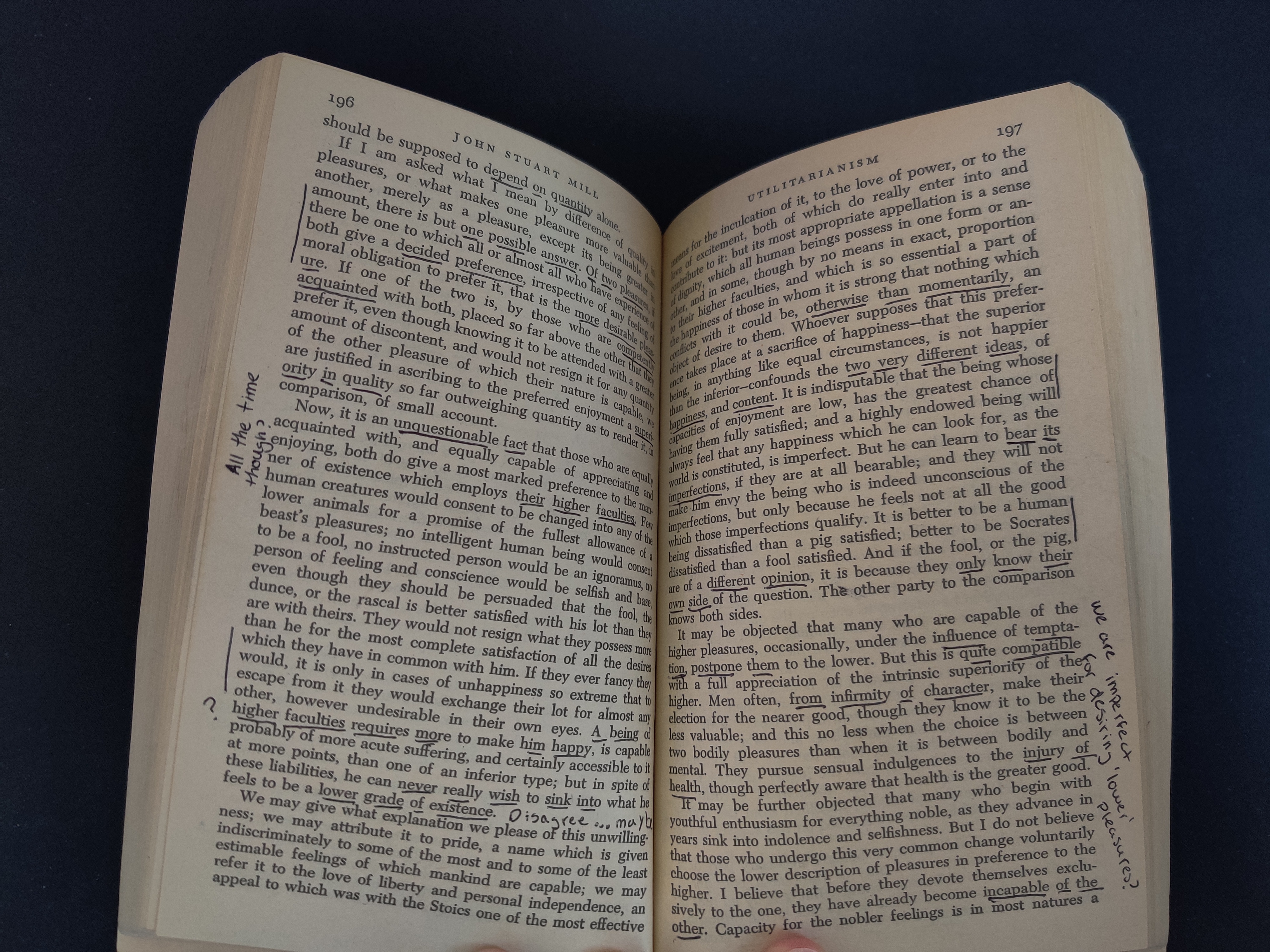
What does John Stuart Mill say about Utilitarianism?
According to Mill’s theory of Utility, as outlined in Utilitarianism (here is a link to a free copy of the book), we should act so as to keep the happiness of all human beings in mind, although the theory could be adapted to include all animals as well. We value equality, so we should care about the rights, freedoms, and happiness of our neighbors at the same time as we care about our own. As a result, he outcomes of our actions should be the primary thing we care about because we always act to produce a certain outcome, namely, happiness or pleasure. This is known as the Greatest Happiness Principle, or GHP for short.
What is the Greatest Happiness Principle?
To begin with, Mill actually states his Greatest Happiness Principle very simply in the opening pages of Utilitarianism.
“…actions are right in proportion as they tend to promote happiness, wrong as they tend to produce the reverse of happiness.”
– John Stuart Mill, Utilitarianism
Pretty simple. The only thing to remember here is that all happiness is treated equally. We can’t act to only produce our own happiness, that would be very immoral.
However, Mill defines Happiness as the feeling of pleasure, and the absence of pain, and unhappiness as pain without pleasure. Unfortunately, there is a sort of aversion to the word pleasure, as if pleasure is some hedonistic concept that makes people neglect morality.

Photo by Wendy Wei on Pexels.com
How do we Rate our Happiness?
Mill clarifies his thoughts on the idea of pleasure by invoking some straightforward thinking. Let me use a modern-day analogy to better show his argument. If we wanted to figure out what the best movie of all time was, we might ask movie critics. We might conduct a survey with people who are avid movie watchers, they have seen a lot of movies, so they may have a good idea of what the best one is. Now let’s take this same idea, but with pleasure.
If we wanted to figure out what the best pleasures were, maybe reading a novel as compared to getting drunk, we would ask people that have experienced both and see which one they prefer. This is what Mill calls a competent judge or someone that has experienced a lot of pleasures and is competent enough to determine which ones are better than others. Just like our movie critic is a competent judge of movies, the pleasure critic is a competent judge of pleasures.
When using this line of reasoning, it seems that competent judges generally prefer reading a novel to getting sloshed. Or maybe going on a trip through Europe, rather than spending the money on a new iPhone or drugs.
So, not all pleasures are equal, and some forms of happiness are preferable to others, albeit, at different times. What is important is both the quantity and the quality of the pleasure experienced.
What are the objections to Utilitarianism?
Now that we have a fundamental understanding of Utilitarianism, we can look at some of the prominent objections to the theory to see if they hold water. *Important* Not all of the objections can be discussed here, as some require the theory to be more nuanced to understand, but I urge you to read the text yourself to hear how Mill himself counters these objections. The book is very short for philosophical work and not the most challenging one to read.
Main Objection: The train analogy mentioned at the beginning of this article is the most common type of objection I have heard. Here is a link to an objection of this type on the website Psychology Today. The specific one used in this article follows like this:
- In a small town, a crime has been committed.
- The townspeople are pissed and causing unrest.
- If you were a judge who believes in Utilitarianism, you would find it morally permissible to condemn an innocent person to appease the mob.
This is a rather pernicious straw man of Utilitarianism. The objection tries to show how Utilitarianism is not compatible with the idea of Justice and individual rights, but this is not the case at all.

Firstly, Mill outlines his view of justice and morality in the second half of Utilitarianism, and the two concepts are deeply respected, but occupy different areas. Justice, for Mill, protects the rights and freedoms of individuals in order to provide benefits for the people. You can demand someone to respect your rights, but you cannot demand someone to treat you morally, like being generous towards you. We all have to feel secure that we are equally protected. It would not be an ideal world if the government could sweep in and deprive us of our rights, freedoms, or even our very lives, at any moment.
This is exactly why we should not kill the innocent person to appease the crowd. A precedent would then be set which undermines the security of all in the town. Think of living in Salem, Massachusetts, and wondering if you’ll be accused of witchcraft (in 1692, of course). Accusing and condemning innocent people is not for the benefit of everyone’s happiness if we believe that security and equality are better than revenge or appeasement. No one wants to worry about “What if that happens to me?”, so we should do our best to make sure our actions are backed up by evidence and consideration of the facts. Long-term effects must also play a role, not just “in the moment” pleasures which is what a lot of critics seem to address exclusively.
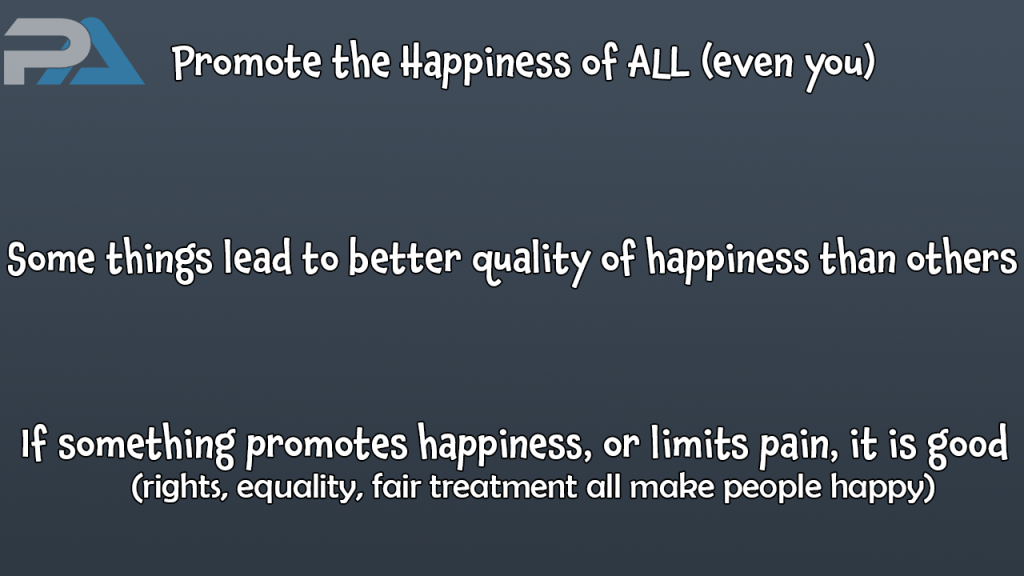
Other Objections: There are a variety of objections that can be created against Utilitarianism, and unfortunately it is not within the scope of this article to address them all (Here is a helpful resource if you are interested). However, we can use our understanding of the principles of Utilitarianism to counter many objections. For that reason, I have created this image to try to make it as simple as possible. Yet, there is a lot more complexity than I have addressed here, so for that reason, I recommend reading the book itself (it’s only about 60 pages).
What is the greatest strength of Utilitarianism?
Utilitarianism provides a practical, straightforward, and somewhat intuitive approach to ethics which makes it very easy to apply to everyday life. Human beings are already Utilitarians of a sort. We recognize that we should care about others, and their freedoms, we just haven’t had a theory outline our beliefs in such a way. If we were all devout Utilitarians, the world would be in a much better place as the happiness of all would not remain as a part of an old theory, but as the actual standard by which we act. Utilitarianism is not deserving of the criticism it has received, and Mill was probably correct when he asserted that its misunderstandings were its biggest obstacle.
 Philosophy Applied
Great article. Touched on ideas I never really thought about.
LikeLike